


On the day before our drive to Monteverde, we had very strong winds at night in the Esterone area. Palm trees scraped along our metal roof all night long, punctuated by the occasional bang of a branch hitting the tin surface.
The next morning, as we wound our way out of the region along the only dirt road, about one mile before we came to the junction of highway 150, which leads up towards Nicoya, a fairly large tree had fallen across the road and landed on the power lines and was suspended about ten feet in the air. We were about five cars back from where the tree had fallen and at first, cars were turning around on the road but when I looked at Google Maps, I couldn’t find anyway out of the area and wasn’t sure what to do.
So we waited.
Within five minutes, men simply appeared on the side of the road with chainsaws and began cutting the smaller branches off the trees. They made a space large enough for the small car in front of me to pass through, which was encouraging. Then, not five minutes later, a municipal truck arrived. Their crew brandished larger chainsaws and within fifteen minutes, the tree was cleared and we were on our way. Pretty damn efficient work !
We were free to continue on our travels to the cloud forests of Monteverde.


About the Monteverde area.
The Monteverde area is one of the few places in the world with cloud forests, which cover less than 1% of the world’s forest area, and like everything on our planet, are declining rapidly.
Monteverde sits at the top of the Tilaran Mountain Range on the border of the Continental Divide, which splits the Americas between the Pacific Coast and the Caribbean coast. Warm winds from the Caribbean cool and condense into clouds as they sweep over the mountains. These thick clouds are filled with moisture and hang over the elevated forests.
The area’s high altitude, between 4,200 – 5,900 feet, means the weather is much cooler. When we left Esterones de Samara in the morning, it was a warm and sunny 27 degrees . When we arrived in Santa Elena, it was 13 degrees and raining.
The result? Cloud forests.
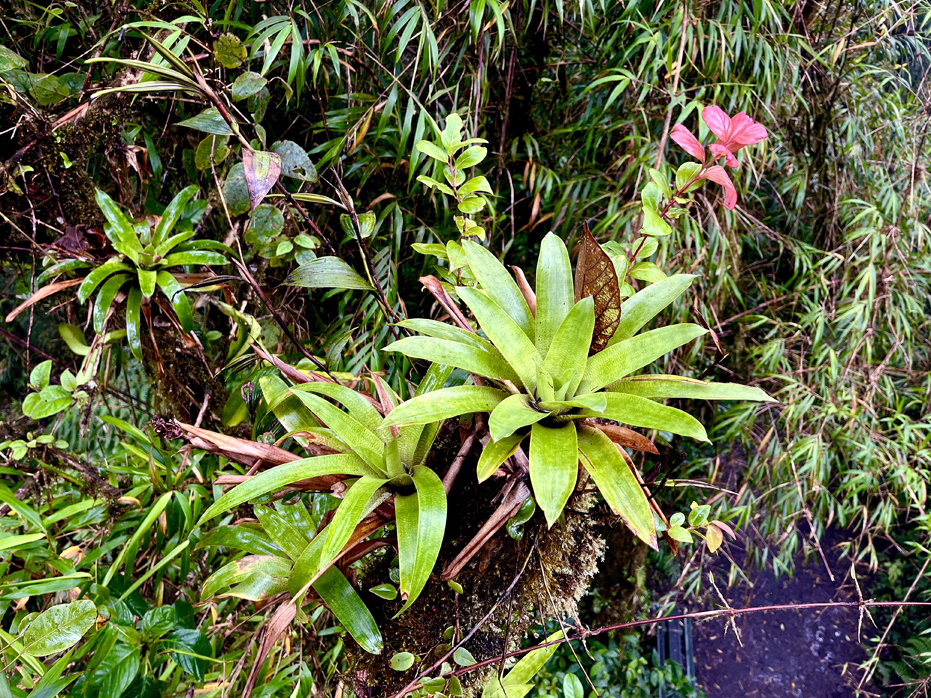
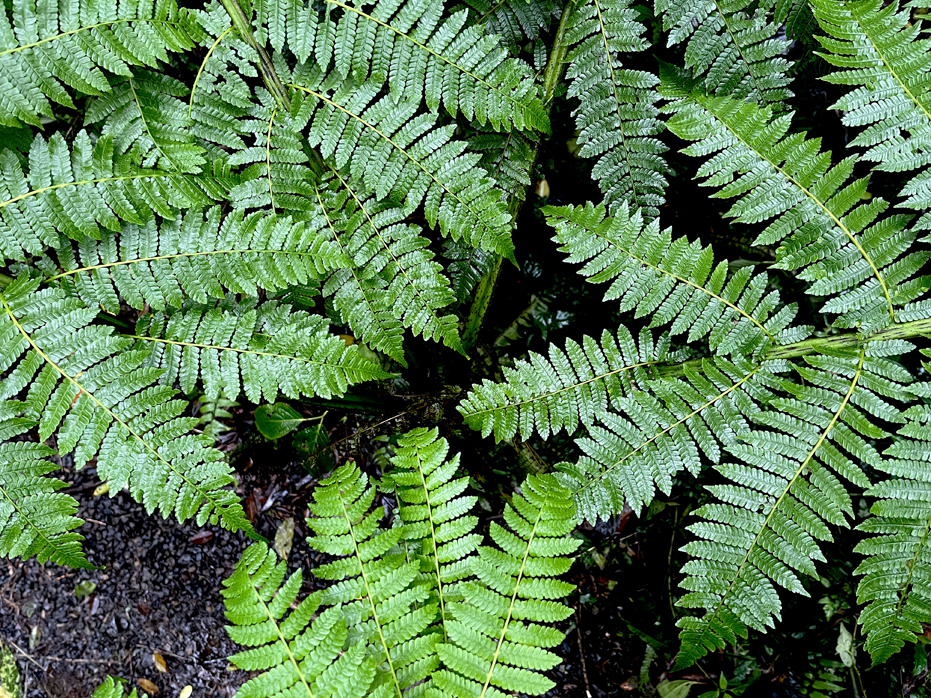
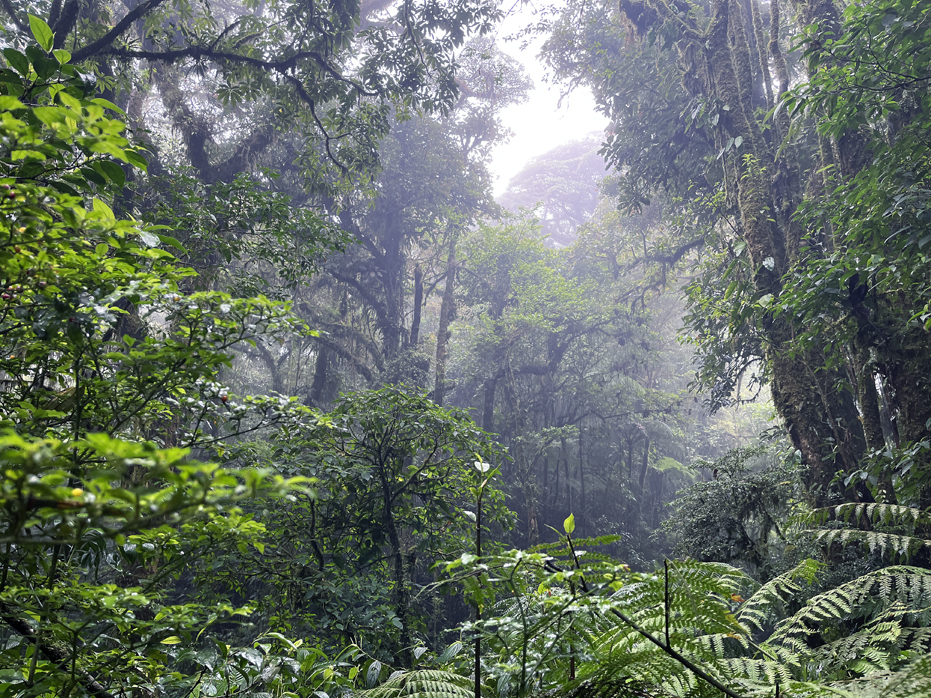
With over 180 inches of rain annually and year-round humidity of 100%, these forests are constantly bathed in clouds, which creates the perfect environment for a wide range of tropical plants, which grow on almost every surface, as well as covering most of the forest floor, tree trunks and even their roots. The forest is full of life, and is dense green everywhere you look as you will see from the photos below that we took on these next two hikes.


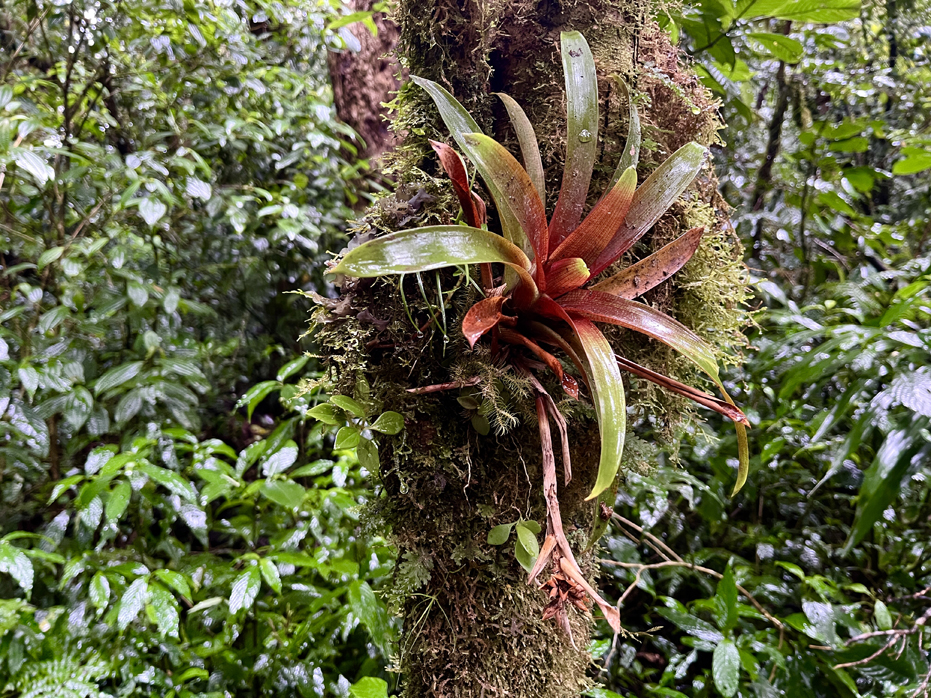


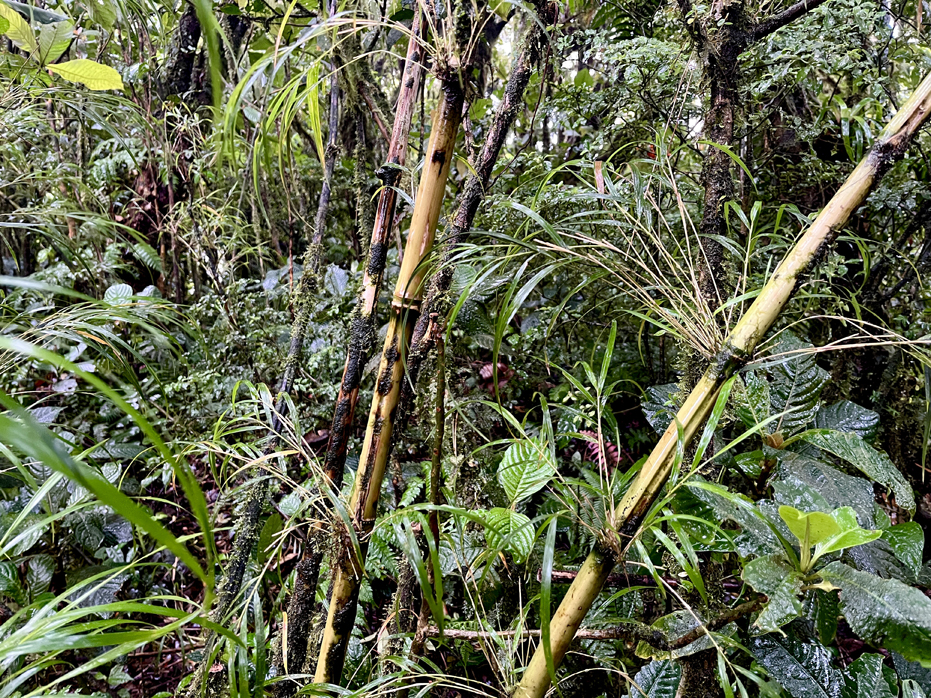
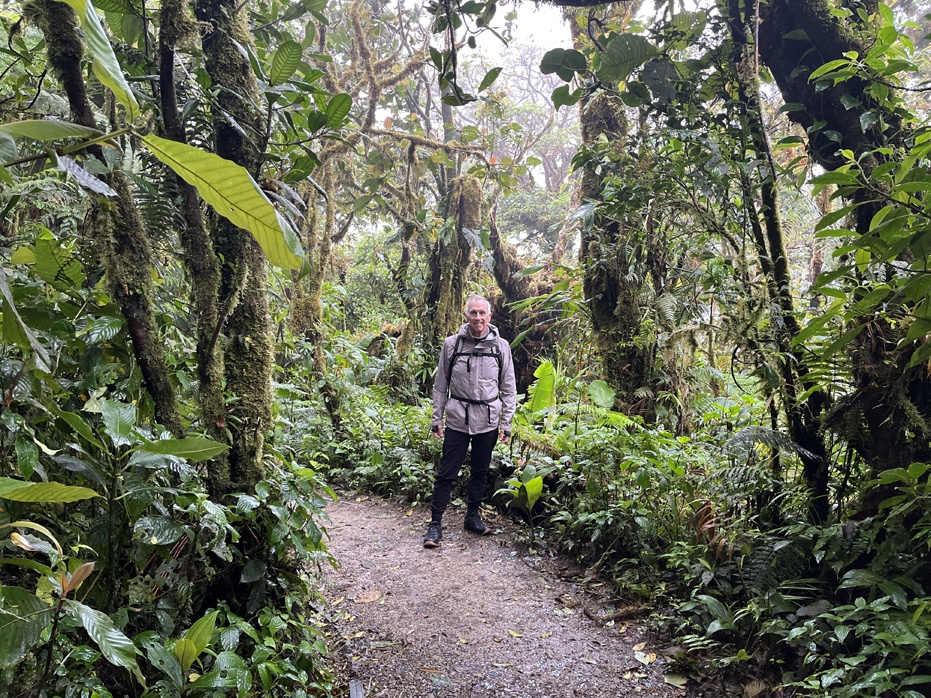
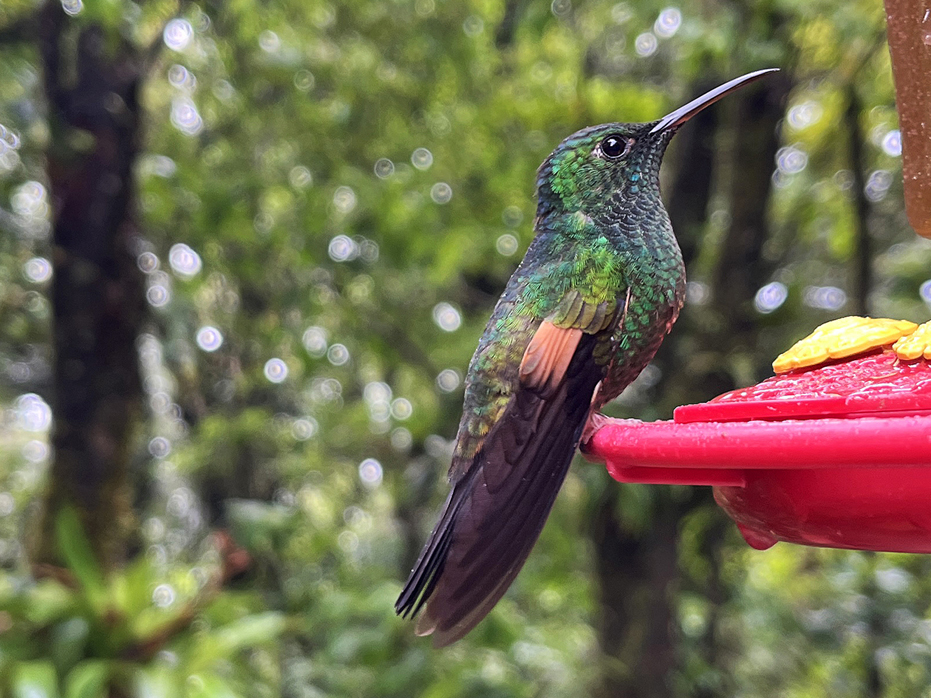
The Monteverde Cloud Forest Biological Reserve is one of Costa Rica’s most visited landscapes. It’s a popular destination for tourists that are here for short periods of time. Bus loads of people arrive daily so this park is busy. There is a visitor parking center which provides a shuttle up to the entrance of the park, which is very nice if you are visiting with a car because the roads are awful and there’s no parking to be found.
It is perched high along the Tilarán Mountain Range where warm Caribbean trade winds rise, cool, and condense into persistent mist and subsequently, drain back towards the Caribbean.
This near-constant cloud cover cloaks the forest in a shifting veil, which supports a dense tapestry of mosses, orchids, bromeliads, and towering trees draped in epiphytes. The air is damp and the scent of the earth and foliage surrounds you. While it is renowned for its extraordinary biodiversity, the reserve apparently shelters hundreds of bird species, monkeys, sloths, and countless insects and amphibians, we saw virtually no signs of that life.
The reserve was founded in the early 1970s through the vision and determination of a small group of North American Quaker settlers who had moved to Costa Rica’s highlands. Concerned that expanding cattle ranching and logging were destroying the unique cloud forest on the western slopes of the mountains, the settlers and a few conservation-minded scientists worked to purchase the first parcels of land to set aside for protection. Their goal was to preserve the forest’s extraordinary biodiversity while also maintaining watershed health for the surrounding communities.
The Continental Divide is a high-elevation chain of mountains that separates the flow of rivers and streams toward opposite oceans—rain falling on the Monteverde side eventually drains to the Pacific, while rain on the higher elevation of Santa Elena flows to the Caribbean side.
It has been very successful. Over time, additional land acquisitions expanded the reserve to its current size of roughly 10,500 hectares, creating a connected corridor of protected highland forest. Today, it operates as a privately managed reserve.
We were excited to visit and found the check in process pretty well managed. The shuttle ran smoothly and on time and once we were at the entrance, park access was easy. For the first section, we were trying to absorb everything around us and keep our footing, as the walkway is made of a kind of waffled cement block. The trail starts off made of three blocks in width but after 30 minutes or earlier, the middle block vanishes and leaves a hollow in the centre of the trail, which made us have to watch our step rather than enjoy our surroundings and we didn’t care for that.
There is also a section of the trail where we were walking along an obvious maintenance road rather than a preserved trail and we both found that these two issues took a lot away from our enjoying this experience as much as we had hoped for. Overall, we were a little disappointed.
We did love the hanging red bridge, which really allows you a deeper look into the density of the forests as you are out over the centre of the gorge below. That was the highlight for us. The mood was so beautiful there.
After we finished the hike, I enjoyed the little hummingbird garden and we took our lunch bag off to the very nice visitors centre area and ordered a couple of cappuccino’s and enjoyed our egg salad & avocado sandwiches.
We found our next hike to be a far better overall experience.

The Santa Elena Cloud Forest Reserve offered us a quieter, wilder experience.
This forest feels more intimate and atmospheric—narrow trails wind through dense stands of stunted, wind-shaped trees thick with mosses, lichens, and orchids – every branch seemingly alive with epiphytes.
The persistent cloud cover, due to the higher elevations along the continental divide, creates a soft, muted light along the trails, and the air had a refreshing chill that contrasted sharply with the lowland heat we had experienced in Esterones de Samara.
The Santa Elena Cloud Forest Reserve is unique in Costa Rica because it was created and is still overseen by the local community rather than a national agency. In the late 1980s, teachers and students from the Colegio Técnico Profesional de Santa Elena led a grassroots fundraising effort to purchase land for conservation, motivated by a desire to protect watershed resources and create long-term educational and employment opportunities.
Today, the reserve is managed through a community-based model in which tourism revenue helps fund the high school’s programs, scholarships, and facility improvements. Many guides and staff are local graduates, and environmental education remains central to the reserve’s mission, with students directly involved in conservation work, trail maintenance, and research support. So when you walk along its trails, you are not just entering a protected forest, but supporting a living example of rural stewardship where conservation, education, and community development are intentionally intertwined.
If I was visiting the area for a short period of time, there’s no doubt I would choose Santa Elena first. We found it a much better experience. There were markers along the trail system which we were well maintained and we always felt like we knew exactly where we were. The trails were packed stone and evenly flat throughout the entirety of our two hour walk.
One really thought provoking addition to these trails was the inclusion of a Shinrin-Yoku walk. As you you enter a portion of the hike, you are asked to look around and find a stone which speaks to you, It is suggested you carry that rock along todays journey and, after a safe passage, deposit it in a basket, which was filled to overflowing. I found this allowed us to stay very present. Along this trail, there was a series of asian sayings in support of the concept along the way, which fit the trails well.
This was, by far, the better of the two Cloud Forest options, in my opinion.
If you are visiting, the roads leading to both hikes are in very poor condition and the road leading to Santa Elena is terrible.




Don Juans Coffee, Cacao and Sugarcane Tour
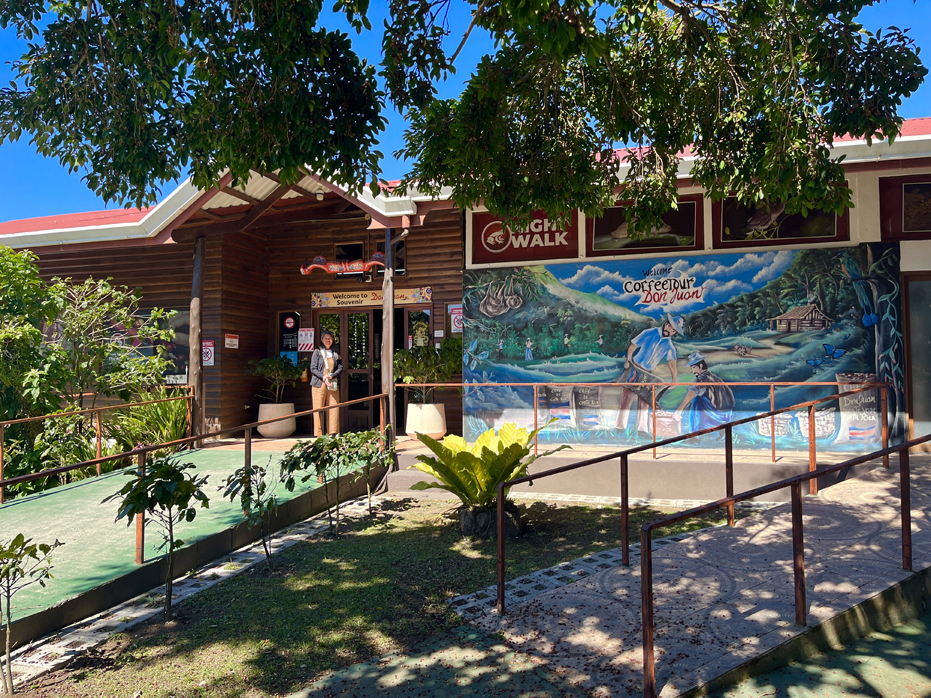
On an absolutely beautiful morning high up in the mountains, we visited Don Juan’s Coffee Plantation for what was quite possibly our favourite tour in Costa Rica.
Our small group was led by a well educated young man named Julio with a nice sense of humour. From the moment he welcomed us, he had our attention.
The tour was an easy and leisurely walk throughout the plantation, which was surprisingly small – only 13 acres – and tours were obviously a mainstay of the operations. Over the next two hours, Julio explained the entire process of coffee cultivation – from how to recognize and pick a ripe cherry on the plant through fermentation, drying, roasting, and finally to tasting freshly brewed coffee — while explaining the cultural and economic importance of coffee in Costa Rica, as well as why the coffee at this particular plantation was so good.
It turns out that Costa Rica has a law banning low quality coffee varietals. Think about that the next time you are buying coffee. Costa Rica prohibits the commercial planting of low-quality robusta coffee beans, allowing only high-quality arabica varieties to be grown. Arabica coffee develops more complex flavours—floral, fruity, and chocolatey notes—while robusta tends to be harsher and more bitter. This national law helps keep the country’s overall coffee quality consistently high.
We also learned that none of the coffee grown on this particular farm was exported. Virtually all of it was consumed by the local population and visitors to the plantation. It turns out that most of the big coffee buyers back in North America, none of whom were directly referred to during the tour, but probably companies like Tim Hortons or Starbucks as examples, are unwilling to pay the extra cost for the higher quality beans. The coffee they did export was all of poor quality, destined for the countless bags of pre-ground coffee sitting on the shelves for a year at our local grocery stores.
Think about these things the next time you buy your coffee. Think about the types of farms which grow food properly and what you really want to be ingesting, if you drink coffee daily, like most of us do.
Learning about food is fascinating for me and little bits and pieces of our Costa Rican adventure were really ‘light bulb’ type of moments for me. This was one.
The plantations around Santa Elena sit at 4,200 feet above sea level, which is prime altitude for high-quality coffee. At this elevation the cooler cloud-forest climate and rich volcanic soils slow the maturation of the coffee cherries, which concentrates sugars and produces more nuanced flavours.
Then it was off to the Cacao segment of our tour. We were introduced to a cacao tree, and were shown a variety of cacao pods. Julio showed us how to open the pod and enjoy the sweet pulp surrounding the actual beans. We learned how the cacao beans are fermented, roasted, cracked, and ground before he made the the group of us some chocolate right on the spot, using a rudimentary mortar and pestle stone.
Last, but certainly not least, was the sugarcane. This included a really great demonstration of how cane is pressed to extract the juice, and Yim got to help press the sugarcane so it was a fun overall experience. It made me want to ask my local grocery store to bring in some sugarcane this summer.
After our tour, we stopped in at their store. Their staff are very friendly and we enjoyed tasting the different varieties of coffee and chocolate, of which several bags made their way back to Canada with us.
We highly recommend a visit.


Santa Elena
It’s an odd town. There’s bits and pieces of it spread out over a pretty wide area but the downtown core has pretty much everything a traveler could want. Several decent grocery stores, a couple of pharmacies, lots of restaurants and a wide variety of souvenir type shops. There’s an actual little shopping mall in one part of town, which was surprising.
As far as restaurants in the area, they are everywhere. The place is packed with restaurants.
Here’s the ones we ate at:
Sabor Tico is a classic Costa Rican “soda”—a casual, family-run restaurant that focuses on traditional home-style cooking rather than touristy cuisine. The restaurant was started by a local family more than two decades ago with the goal of sharing authentic Costa Rican cooking and hospitality with visitors and locals alike and we really enjoyed our meal here.
Farm-to-Table. This restaurant sits in a small private nature reserve and organic farm just outside Santa Elena. It is surrounded by their own gardens, forest, and walking trails and the restaurant follows a genuine farm-to-table approach, meaning many of the ingredients used in the dishes come directly from the farm and very organic gardens on the property. Plus, it has an incredible view of the sunset. We highly recommend this stop for dinner.

One more thing to see…
Just outside Santa Elena, a short forest trail leads to the Ficus la Raíz, a remarkable root bridge born from a fallen fig tree. Instead of dying, the tree’s roots grew downward, weaving together into a natural arch over a small creek. It’s a brief stop, but the intricate lattice of living roots and the quiet simplicity of the surrounding forest made it a memorable example of nature’s resilience and creativity.
The path is an honour system and costs $1,000 colones per person, roughly $3.00 CDN.
If you are considering visiting the area, we stayed in a small Airbnb in Santa Elena.
Where we stayed
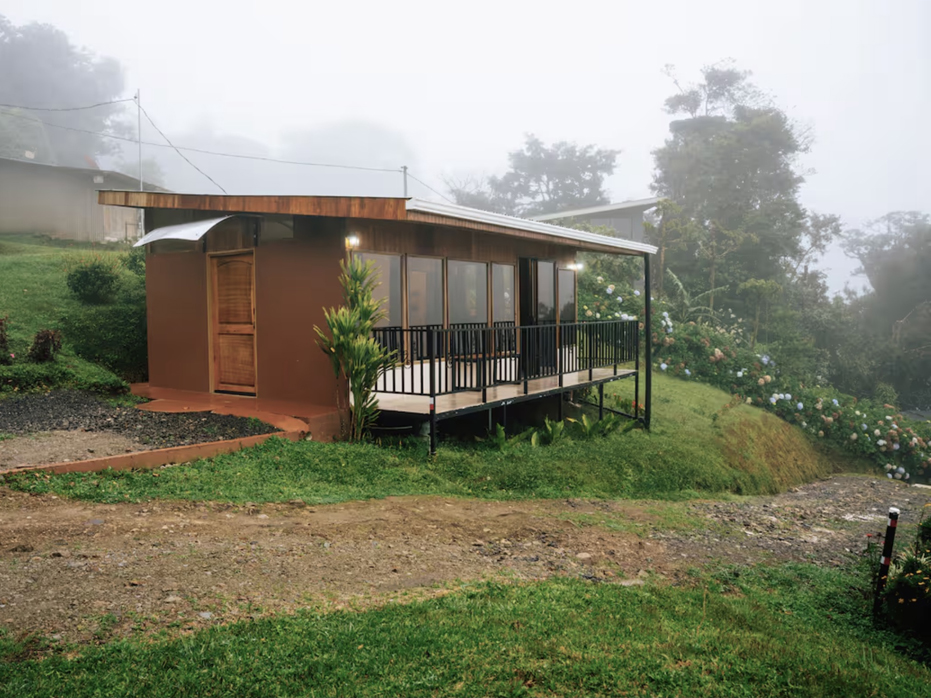
Our little container-proportioned home was located up off the main road about a fifteen minute drive along a mostly decent gravel and dirt road. As we wound our way up, we passed through lush valleys which held clouds within them and then, a minute later, we would be above them on the other side of another valley.
If you are visiting in January, February or March, make sure you insist on a decent sized space heater because we were quite cold in here.
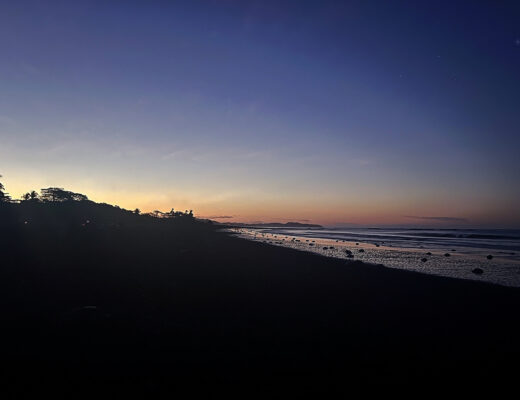
Built into the slope overlooking a westward facing valley and the Bay of Nicoya in the distance, the view is quite beautiful. At night, we could still enjoy the sunsets of Nicoya from the balcony. That was pretty cool. It made me realize what a small country Costa Rica is.
Our next leg of the trip is La Fortuna.


No Comments