


2025 was a particularly cold winter and spring, and the weather in Collingwood did not really warm up until early June, the same month I turned 70 and I decided that I was no longer willing to tolerate five months or more of cold weather annually and we started planning for extended periods of time away in the winters.
This decision has been a while in coming. Covid and Cancer got in the way but it’s full steam ahead now….
In January of this year, we visited Madeira to do some hiking and get a feel of what it was like to spend longer periods away. The island was exceptionally beautiful, had a nice climate for January and some of the best hiking we had ever done but the island is small and after three weeks, we both felt we had experienced everything we had wanted to and knew it wasn’t a place where we would spend an extended period of time annually.
So… when we started talking about where to go next, I suggested that we visit a country which was large enough that we could spend some time, say one month, in a house with everything we needed to live as normally as possible, which had a warm climate, and get a feel for what it may be like to live there for an extended period of time by staying in a small village, and see if that was something we both enjoyed, and how we felt about spending more time away during our winters. I already know I am ready so we have to find a place where we are both happy.
With that criteria in mind, we decided that our longest winter trip to date, since returning from Belize 20 years ago, was going to be seven weeks in Costa Rica in January and February 2026. It’s a destination that had come up regularly in our travel conversations over the years.
From an environmental perspective, I am attracted to Costa Rica’s sustainability programs and biodiversity – it accounts for about 6% of the Earth’s biodiversity and the tourism sector has adopted practices that emphasize environmental, social, and cultural sustainability. Because of this policy, most of the money spent on tourism stays in the country, and that policy has contributed to the preservation of 33% of Costa Rica’s total land mass.
Costa Rica has a long-standing commitment to environmental sustainability. Currently, over 95% of their electricity comes from clean sources – high rainfall in the mountains and thousands of rivers, create a pretty perfect environment for hydropower, which serves as the primary source of its renewable energy. Plus, the country is located on the “Ring of Fire”, which has a dense network of volcanoes, allowing it to tap into significant geothermal energy.
The country also places an emphasis on social well-being and peaceful coexistence – for example, they have no army, which is something I really believe in – and explains why the literacy rate in Costa Rica is over 97%. Rather than finance a Military Force, they redirected those funds into educating their citizens and providing them with Universal Health Care.
And I love the idea of getting away from US culture and media. It’s just not healthy for us to be exposed to it any longer, in my opinion. It’s become too toxic and if we can spend extended periods of time away from that, then I want us to do that. I believe it’s possible for us to heal our brains a little bit by taking a bit of a mental ‘Fast’ from North American culture.
So the house we have rented for the first month of our stay is located between Samara and Nosara, about halfway down the Nicoya Peninsula, and has no television, and I am particularly looking forward to being that disconnected. I may even not post anything on Facebook during this period. I’ll just keep the experience between Yim and I while we are there.
And from everything I have read, the famous Pura Vida lifestyle – slowing down and appreciating the beauty of nature may be the brain food – the antidote – that Yim and I need on our journey together.

Guiones Beach, Nosara
Month One – Samara and Nosara
We chose this area as our initial home base because we both enjoy the lifestyle we have while we are in Collingwood, focused on fitness, dance, cycling and our plant based nutrition. Spring, Summer and Fall, we really enjoy being around our home, enjoying the local free music the town brings in, hiking, gardening and sharing dinners with friends.
While Samara is a quieter village, known as a peaceful, scenic beach town with family-friendly beaches, outdoor activities, and a relaxed vibe, nearby Nosara is well known as a Wellness Centre and a paradise for clean eating, with many establishments prioritizing organic, locally sourced ingredients, making it easy to find healthy plant-based options. It is also one of the five areas in the world designated a Blue Zone; regions of the world where people live exceptionally long lives due to local lifestyles, which combine physical activity, low stress, social interactions and a local whole foods diet so the fit seems really good for us. It certainly sounds like a place we will both enjoy so we will find out.
From the small house we rented, we will have access to many fitness studios, including a gym at Bodhi Tree with everything I currently use daily and Pilates, Zumba and even Ballet classes for Yim, if she likes. There are also some Natural Medicine courses offered and a wide variety of Yoga classes and I think it will be really nice for us to be able to leave the house daily and go to a fitness class together in the mornings, then have lunch and go exploring and grocery shopping for new foods, do some cooking, head down to the beach for, or after dinner and just chill for a month.
I am looking forward to being close to a small town to get a sense of how that would feel. The house comes with two beach bikes so that will be a fun option for travelling in to town. Hopefully, we will meet some like minded people or locals and develop friendships along the way.
Planned Day Trips
One of the day trips we have planned while in Nosara has been on my mind for many years now, which will be a visit to the Ostional National Wildlife Refuge, a globally significant nesting site for Olive Ridley sea turtles. The refuge, which encompasses the beaches of Ostional, Nosara and Guiones, protects the turtles during their mass nesting events known as “Arribadas” (meaning Arrival in English), where turtles come ashore in the thousands, or even hundreds of thousands simultaneously to lay their eggs.
There is a volunteer program at the Refuge which offers opportunities to assist with sea turtle conservation, such as collecting eggs as the turtles arrive, relocating nests, working in the hatchery and assisting with the release of hatchlings and is something I had been very keen on doing prior to Covid cancelling out the chance to do so. The Ostional National Wildlife Refuge is the only place in Costa Rica where you can observe sea turtles nesting the entire year, even on nights without “Arrivals” and we have arranged for private visits with a local Guide. I think this will be an extraordinary experience for us.
We also intend to visit the Punta Islita Wild Macaw Reserve. In fact, there is a Photographers Tour, where you get to spend a morning photographing their Scarlet Macaws flying free at the Reserve without any other visitors and the additional entrance fee helps support their conservation efforts.
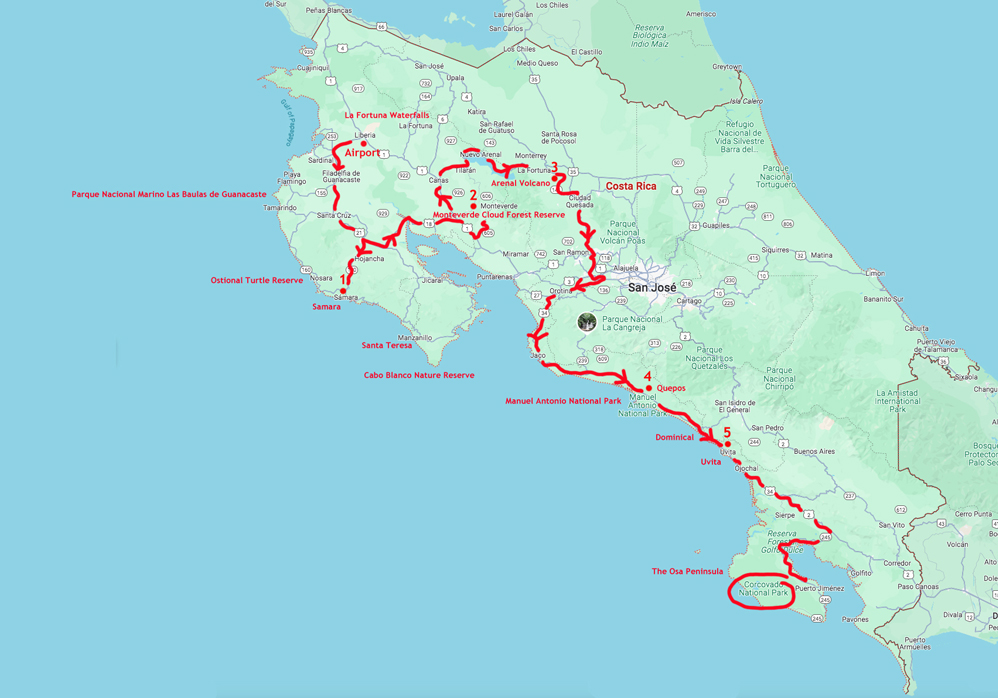
Our travel route through Costa Rica
Month Two – Monteverde, La Fortuna, Quepos, Dominical, Uvita and the Osa Peninsula
Our second month involves some traveling, as we spend a few days visiting the Monteverde and Santa Elena Rain Forests as well as a Coffee & Chocolate Plantation, before heading north to La Fortuna to visit the Arenal Volcano and surrounding area, including a canopy top Hanging Bridges hike, a Zipline through the canopy and a visit to at least one of the many natural hot springs surrounding the volcano, which is still very active and we finish our stay with an organic cooking class, where we pick seasonal local vegetables and prepare our own meals for the night.
From there, we will head south to Manuel Antonio National Park for five days and spend time visiting and enjoying the beaches. We will also visit Rainmaker Conservation Park for a day and night hike with a guide, take a tour of a Vanilla Farm and maybe try a little bit of white water rafting.
From Quepos, we continue south to Dominical, which is described as a laid-back beach surf town. There’s also a well known organic food store there known as Mama Toucans, which we plan on visiting and buying groceries at. It’s important to know where we can find food along our travels for us. There’s also the local Eco Feria Organic Farmer’s Market, where Farmers and vendors sell fruits, veggies, baked goods, sauces, homemade food and drink, crafts, and clothing and the market apparently attracts a lot of free-spirited locals and visitors, giving it a laid back, bohemian vibe.
And our final stop is the small town of Uvita, where we will visit the Marino Ballena National Park and possibly the Osa Peninsula before heading back up to Liberia Airport.
So it’s going to be a good long look at much of the country – lots of wellness time planned, and interesting visits to Turtle Reserves, Rainforests, Volcanoes, National Parks, Coffee Plantations, Chocolate & Vanilla Farms, organic cooking lessons, wandering along beaches and spending time together.
But will we want to go back year after year or are we destined to travel and see new spots annually? Each new trip seems to simply whet our appetite for new destinations…
A Fun Fact. Ontario is 21 times larger than Costa Rica.


No Comments